Yankees and Mets Battle for Top Free Agent Catcher Ryan Jeffers, and the Price Tag Could Hurt Both
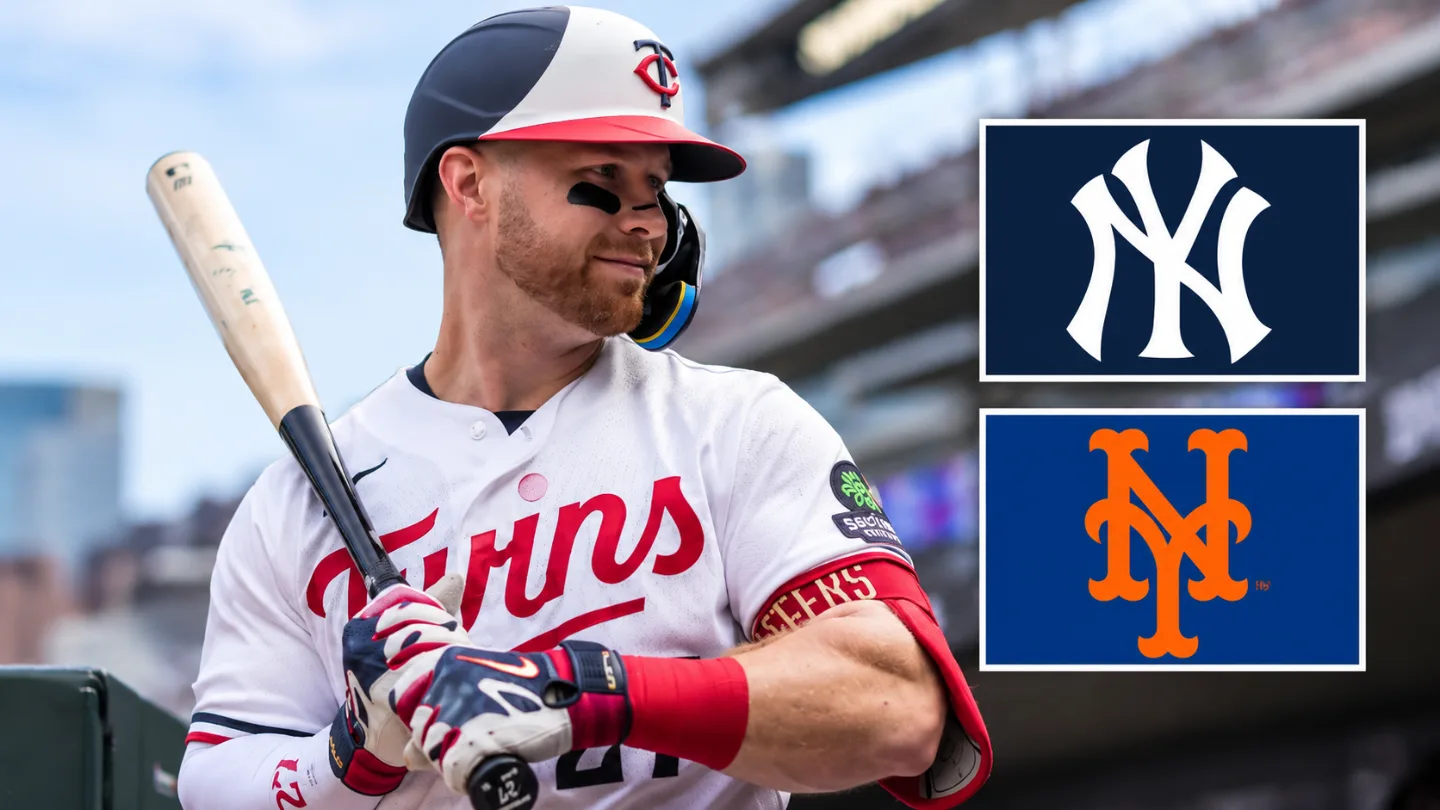
Two New York teams, one right handed bat behind the plate, and a deadline that lands today. The race for the top free agent catcher on the market just narrowed, with a Minnesota columnist pointing straight at the Bronx and Queens. Ryan Jeffers has not signed anywhere, but the buzz says his next address has a New York zip code.
A veteran Minnesota sports columnist said it looks as if the Mets or the Yankees will be the landing spot, and projected a three year deal at about $17 million per season. That works out to roughly $51 million. The Twins attached the qualifying offer to Jeffers earlier this month, and the deadline to accept it is November 17.
The One Year Offer He Is Expected to Decline
The qualifying offer is a one year, $23.15 million tender, and Jeffers was one of eight players to receive it. Seasoned league reporters noted he has until today to accept or decline.
Most analysts expect him to reject it and test the market. Any club that signs him then surrenders draft pick compensation, a cost that matters when a team is already pushing against the luxury tax. Expect both New York front offices to run that math twice.
The offer also confirms how the Twins see him. They are willing to pay $23 million for one more year, which tells you the bat is real.
A report earlier in the offseason put the qualifying offer in his hands, and a league insider flagged that he was expected to hit the open market.
Why the Bat Fits the Bronx
Start with the Yankees. Their catchers posted a .241 BABIP, 28th in baseball, and minus 21.6 offensive WAR, 25th in the league. Austin Wells hit .186 with a .624 OPS and fought cervical headaches for much of the year.
Defense was never the problem. The Yankees’ catching group ranked third in baseball with 21.7 defensive WAR. The hole is at the plate, and Jeffers fills it.
Jeffers hit .256 with a .353 on base percentage and a .461 slugging mark in 2026. He finished with 14 homers, a 119 wRC+, a career best 12.5 percent walk rate, and a strikeout rate near 18 percent. That came in only 368 plate appearances because a fractured hamate cost him roughly seven weeks from mid May to early July.
The Mets Case Is Different
Queens has a different problem. Francisco Alvarez hit .233 with a .311 on base percentage and 16 homers, and he has missed 135 games over the past two seasons. Luis Torrens is signed through 2028 and posted a .691 OPS.
The Mets do not need a replacement. They need insurance and a lefty bat to pair with Alvarez. Jeffers gives them both.
One national columnist went further and said Jeffers “sounds like a Met.” That is opinion, not reporting. Still, it reflects a team with more catching depth that can afford to get creative.
What Two Catcher Deals Tell Us About the Price
Contract benchmarks matter here. J.T. Realmuto signed a five year, $115.5 million deal with Philadelphia in 2022, the gold standard for a complete catcher. Willson Contreras then landed five years and $87.5 million from St. Louis that winter, even though his defense drew questions.
Jeffers is not Realmuto. He is closer to Contreras, a bat first catcher with defensive warts. His caught stealing rate fell to a career low 10.6 percent in 2026, and his framing grades as roughly average.
That is why projections vary. One national projection from a respected transaction site has him at four years and $75 million, while the Minnesota columnist is lower at three years and $51 million. The gap between those numbers is the negotiating room.
What Could Go Wrong
Here is the skeptical read. Jeffers is 29 and turns 30 in June. He had a career year in his walk year, and his production dipped after the hamate injury, a pattern that makes agents nervous and front offices cautious.
A four year deal into his mid thirties is where this goes bad. Catchers age faster than any other position, and the numbers behind the plate get ugly quickly. If a team pays him like an everyday star and he slides into a platoon role, that is dead money.
There is also a competition angle. A league insider reported that Boston emerged as a surprise pursuer of Jeffers, even after trading for Adley Rutschman at the deadline.
The Yankees also have history here. They were outbid by the Mets for Juan Soto in 2024, and a Jeffers trade looked likely at the 2026 deadline before it fell apart. Another loss to the crosstown rival would sting.
The Calendar and the Dominoes
The first domino drops today, when Jeffers decides on the qualifying offer. A rejection opens the bidding and starts the clock on every other catcher on the market.
The second deadline is December 1. The collective bargaining agreement expires then, and a lockout could freeze transactions. That pressure usually pushes teams to finish big deals early, which favors a front office willing to move fast.
After that comes the Winter Meetings, where agents turn rumors into offers. If the Mets sign Jeffers, the Yankees will have to look at the next tier, a thin market by every account. If the Yankees win, the Mets can pivot to a different upgrade and keep Alvarez as the starter.
Either way, the loser gets squeezed. There are only so many catchers who can hit, and a few teams from Philadelphia to Anaheim are watching this race.
A Free Agent Catcher Market With Two Obvious Suitors
The buzz is real but not a done deal. The Minnesota columnist who started this has a track record covering the Twins, yet no team has confirmed interest, and one projection still lists the Phillies and Twins as landing spots.
For now, the smart money says New York. Whichever club signs the top free agent catcher will pay for an offensive jolt, and the other will spend the winter looking over its shoulder. Both lineups desperately need what Jeffers brings behind the plate.