Yankees Promise 12-Year-Old Luis Cruz $2.7 Million. Nothing Is Binding.
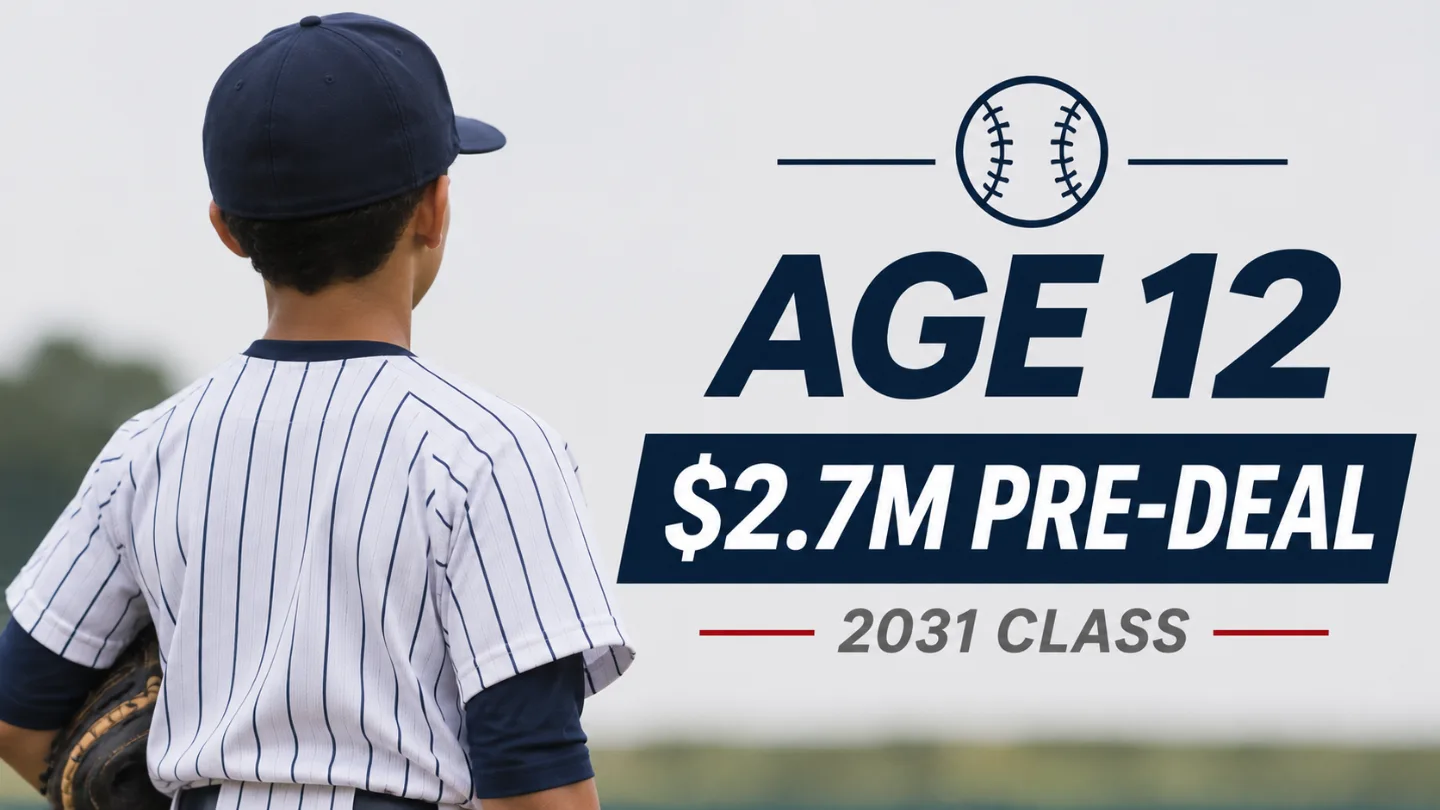
"Potential impact shortstop." That's the pitch attached to Luis Cruz, a 12-year-old Dominican prospect, after word spread Sunday that the Yankees reached a $2.7 million pre-agreement with him. The Yankees 12-year-old story sounds like a coup until you read the fine print: no contract, no signature, and nothing enforceable for four years.
The short version is this. New York holds a handshake, and Cruz can't sign until the 2031 international period opens. Until then, it's a bet with almost no cost and a long list of ways to go wrong.
The Hype Machine Runs on One Tweet
As Heavy writer Jonathan Vankin detailed, the whole story traces to a Spanish-language reporter's post on X. It describes a shortstop who already hits pitches above 90 mph and is the first 2031-class player to commit to the Yankees.
Here's the catch. Vankin's piece and the EssentiallySports account both lean on that single post. Neither offers confirmation from the club, an evaluator who has seen Cruz, or video beyond the reporter's description.
That matters because these deals are marketed. Trainers and agents benefit when a number leaks, since a $2.7 million headline raises the price for the next kid in the same class. The agent, listed in a second post as Lenny Pimentel, has every reason to want this public.
Two Outlets, Two Very Different Takes
Compare the angles. Heavy frames the move as an eye-catching commitment and spends most of its space on process, noting the Yankees' roughly $5.44 million pool for this year's class and that the deal wouldn't count against a cap until 2031. EssentiallySports goes darker, warning that a youngster who gets hurt or fails to develop physically by 16 can leave families empty-handed.
Neither is wrong. Heavy is the better explainer of the mechanics, while EssentiallySports is closer to the real danger. What both skip is the obvious question: why does a club with a $5.44 million pool pledge half of it to a preteen before the kid has played a professional inning?
The answer is positioning. Pre-agreements let big-market teams lock up talent before rivals can bid, and the pledge costs nothing now. It's an option, not a payment.
The Receipts Say Handshakes Break
Look at this year's wreckage. Cincinnati agreed to a $2.8 million deal with 12-year-old Julio Ramos in February and walked away in May after a doping positive, per EssentiallySports. Philadelphia scrapped a $1.3 million pact with a 13-year-old in March over a steroid test.
The Yankees own the loudest cautionary tale. In January they pre-agreed with 13-year-old Venezuelan Albert Mejías for a record $7 million. Forbes reported in February that they cut ties, and Heavy adds that new leadership found the earlier scouting reports inaccurate.
Mario Garza, promoted in January after Donny Rowland's departure, voided that deal within weeks. Seven international staffers were laid off in September. So the people evaluating Cruz are, in large part, a new group still proving they can read a 12-year-old's swing.
There's also the age problem. Big money for preteens tempts families and trainers to misstate birth certificates, which is why a deal can collapse over a number on a document. A kid listed as 12 who is really 14 is a different investment.
Cruz Isn't an Outlier, and That's the Real Story
Don't mistake this for a one-off. Heavy notes Philadelphia has a reported $1.8 million pledge to 11-year-old Venezuelan shortstop David Basabe. EssentiallySports separately reported that the Rays pledged a franchise-record $4.5 million to Maxuel Rosario, a 12-year-old already 6-foot-2.
Against that backdrop, $2.7 million is almost a mid-market price. That tells you the market has overheated. Teams are bidding against each other for 2031 talent in 2026.
Then comes the labor fight. The CBA expires at 11:59 p.m. on Dec. 1, and a lockout is widely expected. ESPN reported the union has proposed stricter enforcement of pre-agreement rules, while the league wants an international draft.
If a draft passes, a handshake made now could be worth nothing. Imagine pledging $2.7 million to a seventh-grader and watching the rules change before he ever hits a growth spurt. The league's stance, as ESPN quoted spokesman Glen Caplin, is that a draft best addresses the root causes of corruption.
Why the Yankees Are Willing to Gamble
Run the cold math. The Yankees are paying nothing today, taking on no dead cap and risking only the optics if the deal collapses. If Cruz develops, they'll have a premium shortstop at a pre-draft price. If he doesn't, they walk.
The downside is reputational. After Mejías, a second voided deal would look sloppy, and the front office knows it. That's why this reads as a more careful bet than the January splash.
So is the Yankees 12-year-old agreement smart or reckless? Probably both, in different proportions depending on what happens in the next four years. Most 12-year-olds never reach the majors, and the Yankees know that.
For now, the only thing Luis Cruz has signed is a place in the 2031 class. Wake us up when there's ink.